Search for "plumber near me" or "coffee shop in Dartmouth" and Google will often show a map with a short list of businesses above the regular results. People call that group the local pack, and for many small businesses it is where a large share of new customers first find them. It is natural to wonder how Google chooses who appears there and in what order.
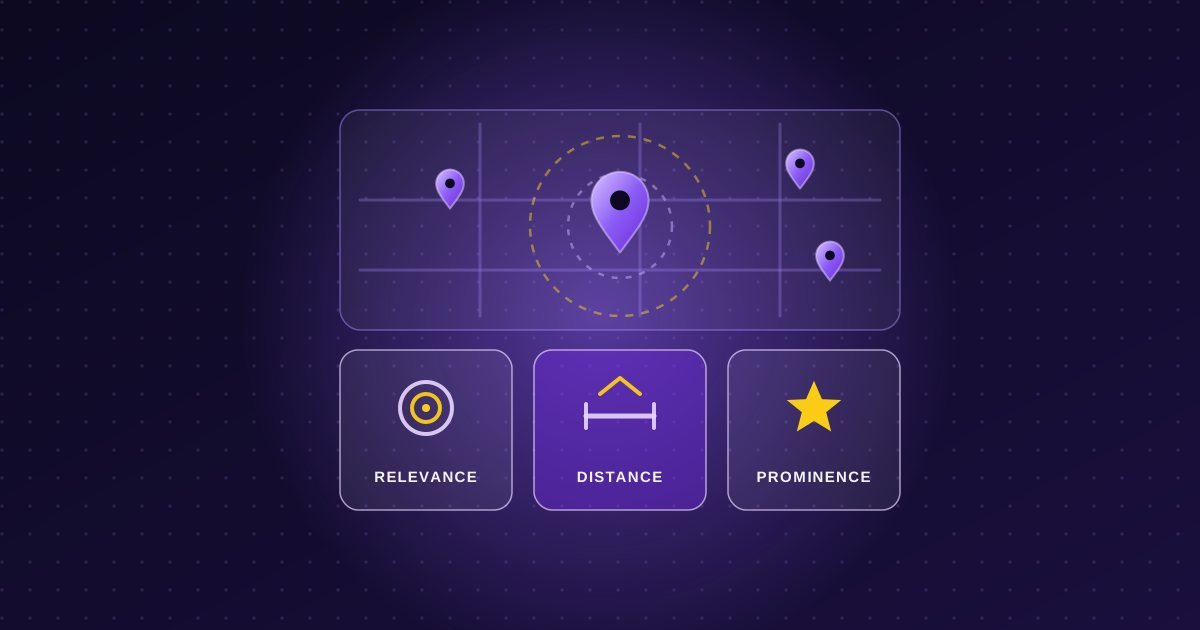
Google publishes a plain explanation for business owners. It says local results are based mainly on three factors: relevance, distance and prominence. No one outside Google knows exactly how those are weighed against each other, and the details change over time, but the three ideas are a useful guide to where your effort belongs.
Relevance: how well you match the search
Relevance is how well your Business Profile matches what the person typed. Google says that complete, detailed business information helps it understand your business and match it with the right searches. In practice, that means:
- Choose the right primary category. If you are a bakery, do not select "restaurant" because it feels broader. The primary category is one of the clearest signals of what you do.
- Add secondary categories where they are true. A business that offers more than one core service can add accurate extras.
- List your services and products. Write them the way customers describe them, in plain words.
- Write a clear business description. Say what you do, who you serve and where, without exaggeration.
- Keep hours and details accurate. Google notes that complete and accurate information, including regular and special hours, makes a profile more likely to appear in relevant results.
Your website supports relevance too. Pages that clearly describe each service and the places you serve give Google more to work with. Our guides to setting up your Google Business Profile and service area pages cover this in more detail.
Distance: how close you are to the searcher
Distance is how far your business is from the person searching. Google says that if the searcher has not shared their location, it uses what it can work out about where they are. This is the factor you can influence least, and it is worth being honest about that. A business across town will not outrank a closer one for a search that is clearly about proximity, no matter how polished its profile is.
What you can do is make sure your location information is accurate and that Google understands your service area. If you travel to customers rather than welcoming them to a shop, set up your profile as a service area business and list the communities you actually serve. Do not list an address you do not operate from, since misleading location details can get a profile suspended.
Prominence: how well known you are
Prominence is how well known a business is. Google says it draws on information about a business from across the web, including links from other websites, and that the number of reviews and the average rating also factor in. In other words, being well known offline helps, and being well regarded online helps too.
Things that build prominence in a natural way:
- Collect genuine reviews. Google says more reviews and positive ratings can improve your local ranking, and recommends replying to them, since it shows customers you value their feedback. Our guide to getting more Google reviews and handling the bad ones shows how to ask without being pushy.
- Earn mentions and links from local sources. Chambers of commerce, community groups, suppliers, sponsored events and local media all create real references to your business. See our post on earning local backlinks.
- Keep your listings consistent. The same name, address and phone number everywhere helps Google trust your details. Our post on local citations and consistency explains how.
What you cannot do
Google is direct about one point: there is no way to request or pay for a better local ranking. Anyone who promises to guarantee you a place on the map is overpromising. Rankings also vary from one searcher to the next, because distance and location change with every search. Two people standing a few blocks apart can see different results for the same words.
For the same reason, be careful about checking your own ranking from your office. You are very close to your own business, so you will likely see a flattering result that your customers do not. A more reliable habit is to look at the views and actions reported inside your Business Profile over time, and at the calls and enquiries you actually receive.
Mistakes that quietly cost visibility
- Choosing a vague or incorrect primary category.
- Leaving hours out of date, especially around holidays.
- Adding keywords to your business name. Your name should match your real-world signage, and padding it can lead to suspension.
- Using a virtual office or someone else's address as your own.
- Ignoring reviews, or replying defensively to the critical ones.
- Having a website with no clear address, service area or contact details.
Maps, search results and the local pack are related, but not identical
People find local businesses in a few different places: the map app, the map results shown inside regular Google Search, and the ordinary web results underneath. The same three ideas of relevance, distance and prominence apply to the map results, but the regular web results lean more on your website's content and its reputation across the web. That is why it helps to work on both. A strong Business Profile with a weak website can leave you invisible in the web results, and a strong website with a neglected profile can leave you missing from the map. Think of them as two halves of the same job.
It also helps to know how customers behave once they find you. Many will look at your photos, read a few reviews, check your hours and then call or ask for directions, all without ever visiting your website. Treat the profile as a small storefront: keep the photos current, answer questions quickly and make sure the phone number reaches a person during the hours you list.
A sensible order of work
If you only have a few hours, start with accuracy: category, hours, services and contact details. Then build your review habit, since it improves both prominence and conversion once someone finds you. After that, strengthen your website pages and local mentions. This is steady work rather than a quick fix, and our post on how long SEO takes sets realistic expectations.
If you would like a second set of eyes on how your business currently appears on the map, you are welcome to get in touch for a free conversation.